
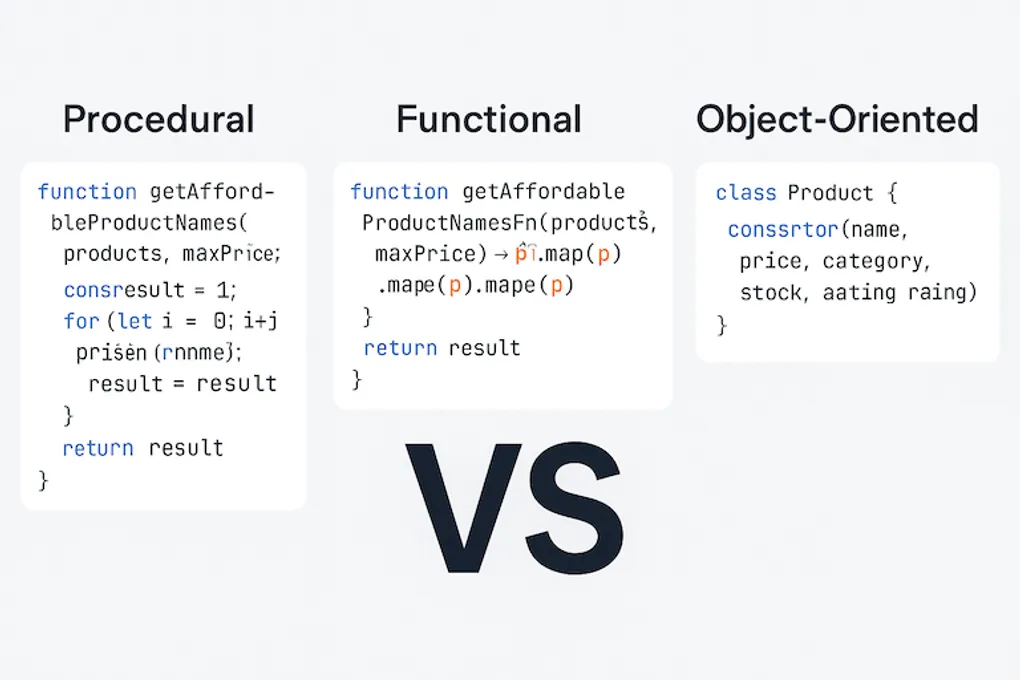
Programming Paradigms in JavaScript: Procedural vs Functional vs OOP
Using the same problem solved three different ways
Modern JavaScript gives you the freedom to solve the same problem in completely different programming styles.
Understanding these paradigms is an essential skill for any engineer because each one shapes how you think about data, state, transformations, and structure.
This post uses code from the following repository:
👉 https://github.com/tobrun/js-programming-styles
The repo implements the exact same problem using:
- Procedural programming
- Functional programming
- Object-oriented programming (OOP)
By comparing them side-by-side, you’ll see how each paradigm influences structure, readability, and patterns—even with the same data, rules, and operations.
1. Problem Statement
We work with an array of products, each containing:
{
  name: string,
  price: number,
  category: string,
  stock: number,
  rating: number
}
We implement three operations:
- Get affordable product names
- Get average rating for a category
- Get inventory value by category
These are realistic everyday tasks in e-commerce, business logic, or data transformation code.
All three paradigms solve the same tasks below.
2. Procedural Programming Example
Procedural programming is the oldest and most direct style: step-by-step instructions, loops, mutable state, and variables that get updated.
Characteristics
- Uses
forloops - Mutates variables directly
- Builds results by pushing into arrays/objects
- Very explicit about how the program flows
Procedural Implementation
function getAffordableProductNames(products, maxPrice) {
  const result = [];
  for (let i = 0; i < products.length; i++) {
    const p = products[i];
    if (p.price <= maxPrice) {
      result.push(p.name);
    }
  }
  return result;
}

function getAverageRatingForCategory(products, category) {
  let total = 0;
  let count = 0;

  for (let i = 0; i < products.length; i++) {
    const p = products[i];
    if (p.category === category) {
      total += p.rating;
      count++;
    }
  }

  if (count === 0) return null;
  return total / count;
}

function getInventoryValueByCategory(products) {
  const result = {};

  for (let i = 0; i < products.length; i++) {
    const p = products[i];
    const value = p.price * p.stock;

    if (!result[p.category]) {
      result[p.category] = 0;
    }
    result[p.category] += value;
  }

  return result;
}
3. Functional Programming Example
Functional programming (FP) focuses on:
- Pure functions
- Immutable data
- Declarative transformations
- Built-in array methods (
filter,map,reduce)
Why FP is big in frontend now?
Frameworks like React, SwiftUI, and Jetpack Compose rely on the idea that UI = function(state).
Functional thinking makes UI predictable, testable, and declarative.
Functional Implementation
function getAffordableProductNamesFn(products, maxPrice) {
  return products.filter((p) => p.price <= maxPrice).map((p) => p.name);
}

function getAverageRatingForCategoryFn(products, category) {
  const ratings = products
    .filter((p) => p.category === category)
    .map((p) => p.rating);

  if (ratings.length === 0) return null;

  const total = ratings.reduce((sum, r) => sum + r, 0);
  return total / ratings.length;
}

function getInventoryValueByCategoryFn(products) {
  return products.reduce((acc, p) => {
    const value = p.price * p.stock;
    return {
      ...acc,
      [p.category]: (acc[p.category] ?? 0) + value,
    };
  }, {});
}
4. Object-Oriented Programming Example
OOP groups data + behavior into classes.
Here it models:
- A
Productclass (data container) - An
Inventoryclass (operations on those products)
Characteristics
- Data and logic bundled in objects
- State stored inside class instances
- Methods operate on internal data
- Mirrors how many enterprise systems are structured
OOP Implementation
class Product {
  constructor(name, price, category, stock, rating) {
    this.name = name;
    this.price = price;
    this.category = category;
    this.stock = stock;
    this.rating = rating;
  }
}

class Inventory {
  constructor(products = []) {
    this.products = products;
  }

  getAffordableProductNames(maxPrice) {
    const result = [];
    for (const p of this.products) {
      if (p.price <= maxPrice) {
        result.push(p.name);
      }
    }
    return result;
  }

  getAverageRatingForCategory(category) {
    let total = 0;
    let count = 0;
    for (const p of this.products) {
      if (p.category === category) {
        total += p.rating;
        count++;
      }
    }
    return count === 0 ? null : total / count;
  }

  getInventoryValueByCategory() {
    const result = {};
    for (const p of this.products) {
      const value = p.price * p.stock;
      if (!result[p.category]) {
        result[p.category] = 0;
      }
      result[p.category] += value;
    }
    return result;
  }
}
5. Paradigm Differences at a Glance
| Paradigm | How it thinks | Key traits | Best for |
|---|---|---|---|
| Procedural | ”Do this, then this…“ | loops, mutation, explicit flow | scripts, simple transforms, performance |
| Functional | ”Transform this into that” | immutability, pure functions, map/filter/reduce | UI, pipelines, predictable logic |
| OOP | ”Model the world as objects” | classes, encapsulation, methods | large systems, domain modeling |
6. Why Functional Programming Dominates Modern Frontend
Modern UI frameworks (React, Vue Composition API, Svelte, SolidJS, SwiftUI, Compose) prefer functional patterns because:
- Declarative > imperative UI
- State flows are predictable
- Views are pure functions of state
- Easier testing
- Less lifecycle management
Functional thinking maps perfectly onto UI rendering.
7. Final Thoughts: No Paradigm Is “Best”
Each paradigm has strengths. None are universally superior.
- FP shines in UI, transformations, and predictable flows
- Procedural shines in explicit logic and hot paths
- OOP shines in structure, modeling, and encapsulation
The real skill is knowing when to use which tool.
A great engineer is fluent in all three—and switches intentionally.